Our Shopify speed optimization service turns slow, bloated stores into sub-2-second speed machines without touching your design. A 1-second delay costs you 7% of conversions, and 53% of mobile visitors leave before a 3-second page loads.
Each subservice page covers full process, deliverables, timelines and pricing — click to explore.
Speed is not a technical problem — it is a revenue problem. Every extra second your store takes to load is costing you sales, search engine rankings and returning customers. And most Shopify merchants have no idea how bad it is.
The average Shopify store scores 28–42 on Google PageSpeed mobile. That means over half your mobile visitors are leaving before your products even appear on screen.
That's not a one-time hit. It's compounding revenue loss that silently grows the longer your store stays slow.
Core Web Vitals are a confirmed Google ranking factor. A poor PageSpeed score doesn't just hurt UX — it actively pushes your store down the results page.
With 60%+ of ecommerce traffic on mobile, a slow store is like turning away more than half your potential customers at the door.
Based on a store with 10,000 monthly visitors and $2,500 monthly revenue
Hosting is rarely the problem: Shopify uses Fastly CDN and its own global network to serve your theme files and images. What slows a store down is what gets added on top. Shopify site speed optimization starts by finding which of these five causes applies to you.
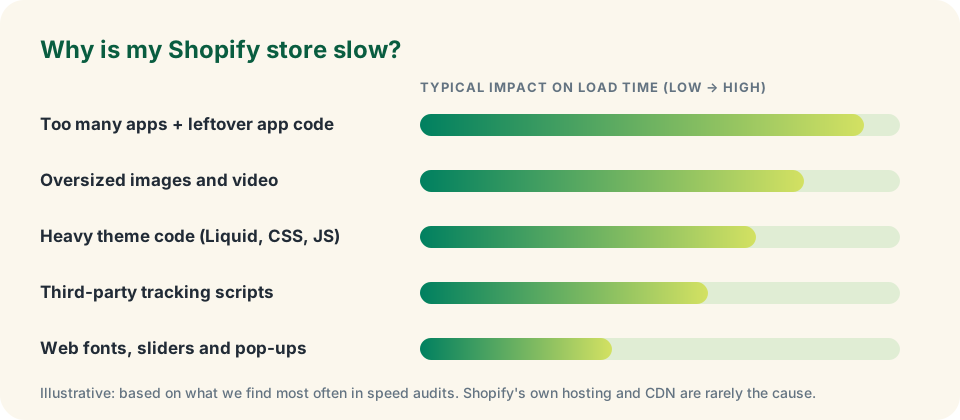
Every app adds scripts to every page, and uninstalled apps often leave code behind in the theme.
Full-size photos and autoplay video are the heaviest files on most product and home pages.
Old or bloated themes load CSS and JavaScript for features you never use. Even the fastest Shopify themes slow down once apps and custom code pile up.
Chat widgets, reviews, tracking pixels and pop-ups compete with your own content to load first.
Several web fonts, carousels and animation libraries push back the moment your page looks ready.
Want to know how to optimize Shopify store speed yourself? These five steps optimize Shopify speed on most stores and improve Shopify site speed on mobile first, and they are the same order we work in. If you are wondering how to increase Shopify website speed beyond these, that is where our development-level work comes in.
Want the full list? Use our Shopify speed optimization checklist or read the Shopify site speed audit guide.
Our Shopify speed optimization services cover four levels, from SEO-focused Core Web Vitals fixes to deep development-level code work. Like all our Shopify store speed optimization services, each one ends with a before-and-after report.
Google's Core Web Vitals are a confirmed ranking factor — and if your store is failing them, your search rankings are being suppressed right now. We fix every Core Web Vital to pass Google's thresholds and protect — and improve — your organic search visibility.
LCP (Largest Contentful Paint), CLS (Cumulative Layout Shift) and INP (Interaction to Next Paint) — we target all three Google ranking metrics and get them into the green "Pass" zone.
A faster store ranks higher. Every improvement to your PageSpeed score is also a direct investment in your SEO visibility — bringing in more free organic traffic month after month.
Google uses mobile-first indexing. We specifically target mobile PageSpeed — the score that directly affects your rankings — not just the desktop score that looks better but means less.
Core Web Vitals fixed for Google rankings
Surface-level fixes aren't enough for a genuinely fast store. Our development-level speed optimization goes deep into your theme code — rewriting inefficient Liquid, eliminating JavaScript bloat, implementing lazy loading, deferring non-critical resources and surgically removing every millisecond of unnecessary load time.
We rewrite inefficient Liquid loops, eliminate redundant JavaScript calls, minify all CSS/JS files and remove dead code that your store never uses but still loads for every visitor.
We implement native lazy loading for all non-critical images and iframes, defer third-party scripts until they're needed, and prioritize above-the-fold content loading for instant perceived speed.
We configure Shopify's CDN headers correctly, implement browser caching for static assets and optimize resource delivery to take full advantage of Shopify's edge network infrastructure.
Deep code-level performance engineering
Images are the single biggest source of page weight on most Shopify stores. Uncompressed product photos, wrong file formats and missing lazy loading can add 3–8 seconds to your load time alone. We compress, convert and lazy-load every image in your store — reducing page weight by 60–80% without any visible quality loss.
WebP images are 30–40% smaller than JPEG at equivalent quality. We convert your entire product catalogue and all theme images to WebP with JPEG/PNG fallbacks for older browsers.
Serving a 2000px image to a 375px mobile screen wastes bandwidth and slows load times. We implement Shopify's srcset image sizing so every device only downloads the image size it actually needs.
Images below the fold are only downloaded when a visitor scrolls to them. We implement native lazy loading across all product images, collection grids and section images to dramatically cut initial page weight.
60–80% page weight reduction without quality loss
Shopify apps are the most overlooked cause of slow stores. Every app you install injects JavaScript and CSS into your storefront — even if you stop using it. One bloated review app can add 1.5+ seconds to your load time. We audit every app, eliminate the dead weight and optimize the essential ones.
When you uninstall a Shopify app, its scripts often remain in your theme code. We audit your entire theme for zombie scripts from uninstalled apps and remove them completely — recovering lost speed instantly.
Not every app script needs to load on page load. We reconfigure essential apps — reviews, chat, loyalty — to load after the main page content, so your above-the-fold experience is fast while apps load in the background.
Some popular Shopify apps are notoriously heavy. If an app is significantly impacting your speed and a lighter alternative exists, we'll flag it with a recommendation — and help you migrate if needed.
Remove the hidden app bloat killing your speed
Every number below is from a real Shopify store we optimized. No cherry-picked exceptions — these are typical results from our standard optimization process.
Every speed optimization project follows the same proven process — whether it's a targeted Core Web Vitals fix or a full development-level sprint. No guesswork, no surprises.
We run a full PageSpeed analysis across your homepage, product page and collection — identifying every bottleneck, slow script and oversized asset.
Free · No CommitmentWe deliver a prioritized report ranking every issue by its speed and revenue impact — so you know exactly what gets fixed first and why.
Within 48 HoursOur engineers execute the fix plan — rewriting code, compressing assets, deferring scripts and eliminating every millisecond of unnecessary load time.
3–10 DaysEvery fix is tested across mobile and desktop before going live. We verify PageSpeed scores, Core Web Vitals pass status and cross-device rendering.
Full QA TestingYou receive a full before-and-after report with PageSpeed scores, Core Web Vitals and load time comparison. We then monitor your store for the support period.
You Own EverythingHow much does Shopify speed optimization cost? It depends on five things, so we quote every store after a free speed audit instead of guessing. Every package delivers a measurable, documented improvement to your speed and PageSpeed score, or we keep working until it does.
More apps mean more scripts to audit, replace or remove safely.
An older or heavily edited theme needs more code clean-up than a modern one.
Large catalogs and video-heavy pages take longer to resize and compress.
Tracking, chat and review tools each need testing once deferred.
One-off sprints cost less than monthly monitoring and fixes.
Every number below is verified — measured before and after our optimization sprint on real Shopify stores.
Any tool can show you a PageSpeed score. We are one of the few Shopify-specialist agencies that understands the direct connection between milliseconds and money, and has the development depth to fix it properly. Our Shopify website speed optimization goes past the score: Shopify performance optimization that shows up in real-user Core Web Vitals and in sales.
Shopify has unique architecture constraints — CDN configuration, Liquid rendering, app injection patterns. We work within Shopify's specific framework rather than applying generic speed advice that doesn't translate.
Speed optimization is invisible to your customers — they only notice the store is faster. We never change your design, layout or brand identity. Every fix happens in the code layer below what they see.
Every project includes a documented before-and-after report showing PageSpeed scores, Core Web Vitals pass/fail status and load time measurements. You always have proof the work was done and it made a difference.
If your PageSpeed mobile score doesn't measurably improve within 60 days of our optimization, we continue working on your store at no additional cost until it does — or refund you entirely.
All optimization work is done on a duplicate theme. Your live store keeps selling throughout the entire project. We only push changes live after full QA testing and your approval.
Every speed optimization project comes with our Performance Guarantee. If your Shopify store's mobile PageSpeed score doesn't measurably improve — or if we don't achieve the Core Web Vitals pass targets we commit to — we keep working at no charge until it does. Still not satisfied? Full refund. No exceptions, no small print.
Honest answers to the questions we hear every week — no jargon, no overselling.
The average improvement across our projects is +52 points on mobile PageSpeed. Most stores we work on go from a score of 20–45 to between 85–97. The exact improvement depends on your starting point — stores with more bloat and more apps tend to see the biggest gains. We assess your store in the free audit and give you a realistic target before any work begins.
No — your store will look exactly the same after optimization. Every change we make is at the code level, below the visual layer. We optimize how your files load, not what they display. Your design, layout, brand fonts and imagery stay completely unchanged. Your customers will only notice that the store is faster.
The SEO Speed Fix (Core Web Vitals) takes 3–5 days. The Full Speed Sprint (SEO + Dev-Level + Images) takes 5–8 days. The App Audit & Cleanup takes 2–3 days. All timelines include QA testing before going live. We always give you a firm delivery date in the proposal — not a range we then exceed.
Zero downtime. All work is performed on a duplicate unpublished theme — your live store keeps taking orders throughout the entire project. We only switch the theme live after full QA testing on mobile and desktop and your approval. The actual switch takes under 30 seconds and causes no disruption.
Core Web Vitals are three specific speed metrics Google uses as ranking signals: LCP (Largest Contentful Paint — how fast your main content loads), CLS (Cumulative Layout Shift — how stable your layout is as it loads), and INP (Interaction to Next Paint — how responsive your page is to user clicks). If any of these fail Google's thresholds, your store is actively suppressed in search rankings — even if everything else about your SEO is correct.
Apps are often the biggest speed killer on Shopify stores — each one injects JavaScript and CSS into every page load. Our App Audit identifies exactly which apps are impacting your speed and by how much. We then defer non-critical app scripts, remove orphaned scripts from uninstalled apps and recommend lighter alternatives where appropriate. The App Audit is available as a standalone service or bundled into the Full Speed Sprint.
The data is consistent across the industry: a 1-second delay in page load time reduces conversions by 7% (Deloitte / Google research). For mobile, the impact is even larger — 53% of mobile users abandon a site that takes more than 3 seconds to load. Across our client base, the average conversion rate improvement following a full speed sprint is +23% — purely from the speed change, with no other modifications.
The code-level improvements (Liquid rewrite, JS/CSS minification, image conversion) are permanent and will not degrade over time. The main risk of speed regression comes from new apps being installed or large unoptimized images being uploaded. This is why we offer our Ongoing Speed Retainer — monthly monitoring and maintenance to ensure your score stays high as your store grows and evolves.
Yes — speed optimization works on all Shopify plans including Basic. Some server-side optimizations (like adjusting checkout page performance) are limited on lower plans, but the vast majority of our work — Liquid code, JavaScript, images, CSS, app scripts — applies equally to every plan. We'll note any plan-specific limitations in your free audit report.
Just three things: your store URL (for the free audit), Shopify Collaborator access (we'll send you a request — it doesn't require your password), and confirmation of which pages are highest priority (typically homepage, product page and collection page). That's it. We handle everything from there and keep you updated throughout with a shared progress document.
Remove apps you don't use and the code they leave behind, resize and compress images, defer chat and tracking scripts, preload the hero image and trim unused theme code. That is how to speed up Shopify website pages on most stores; the rest needs development-level work on the theme.
Usually it is not Shopify's hosting. The common causes are too many apps, oversized images and video, heavy theme code, third-party scripts and too many web fonts or sliders. A speed audit shows which ones apply to your store.
In Google PageSpeed Insights, 90+ is good and 50–89 needs work; many Shopify stores with several apps score 30–60 on mobile. What matters most is passing Core Web Vitals for real visitors: LCP under 2.5 seconds, INP under 200 ms and CLS under 0.1. Shopify page speed data for real visitors is also in your Shopify admin's web performance report.
Yes. Faster pages keep more visitors on the page, especially on mobile, and studies from Google and Deloitte found that even 0.1 seconds faster load times lifted conversions. We measure your before-and-after conversion rate so you see the effect on your own store.
It depends on how many apps you run, your theme code, image and media weight, third-party scripts and whether you want one sprint or ongoing monitoring. We quote every store after a free speed audit, with a fixed price.
Ask for before-and-after Core Web Vitals from real stores, not just lab scores, and check that the agency works on your platform every day. On Shopify, also ask how they handle apps and theme updates. Our process for how to improve Shopify store speed is laid out step by step above.
Pair this service with our other Shopify specialisms for a fully integrated growth strategy.
Speed is a Google ranking signal. Pair speed optimization with full Shopify SEO for maximum search visibility and organic growth.
Learn more →Custom-built, clean-code themes run faster from the ground up. Expert Shopify theme development designed for performance.
Learn more →Build a fast Shopify store from day one. Expert Shopify development with speed-first architecture and PageSpeed-optimized code.
Learn more →Speed is one part of conversion. See Shopify CRO, or replace slow apps with one light custom Shopify app.
Get a free speed audit and find out exactly what's slowing your store down — and how much it's costing you in lost revenue. No obligation, no pressure, just a clear picture and a prioritized fix plan.
We run a complete PageSpeed and Core Web Vitals audit across your homepage, product page and collection page — and deliver a prioritized fix report with estimated revenue impact within 48 hours. Completely free.
Delivered within 48 hours · No obligation · No spam